
 Saad Ullah

⬤ GPT-5.2 just hit a major milestone by running completely on its own for a full week without a single hiccup. This isn't just another incremental update—it's a sign that AI systems are getting seriously better at handling extended tasks without human babysitting. The AI community is now buzzing about what the upcoming METR results might reveal about GPT-5.2's real-world capabilities and how this could shake up the entire industry.
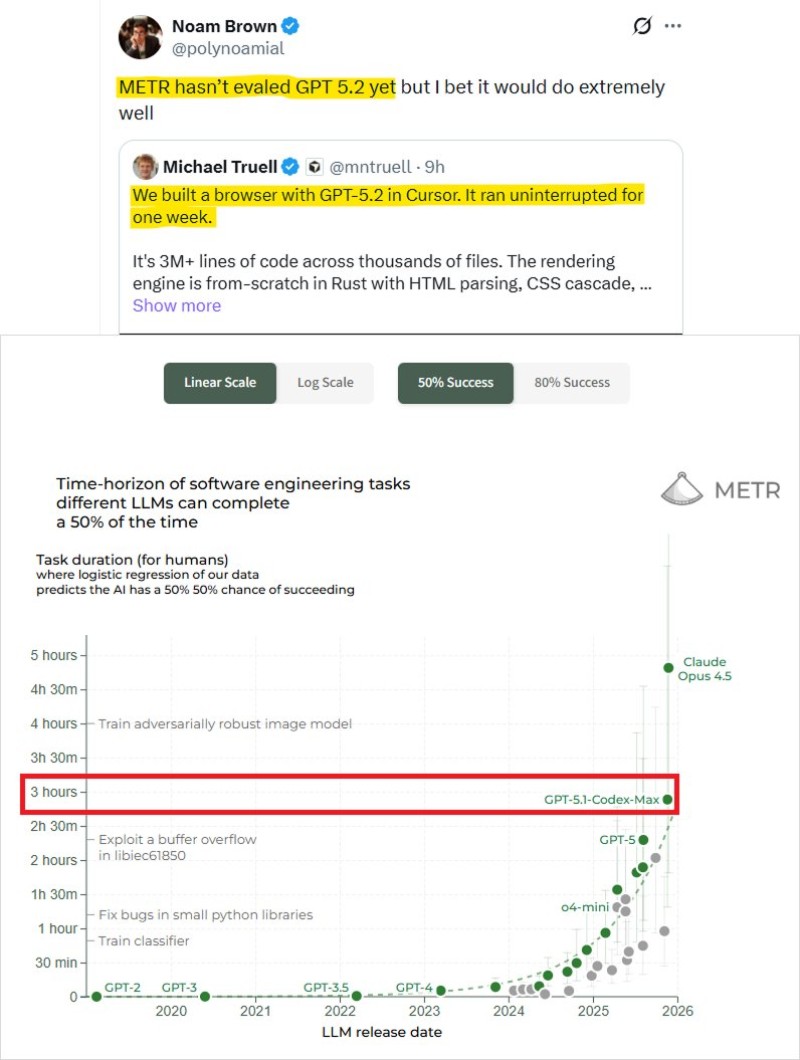
⬤ What's getting everyone really excited are the predictions for future versions. GPT-5.2 xhigh is expected to knock out tasks in roughly 5 hours and 30 minutes while maintaining a 50% success rate. The Codex variant could push past 6 hours, meaning these models are getting faster and smarter at tackling increasingly complex work. We're talking about AI that can handle sophisticated tasks in a fraction of the time previous versions needed.
⬤ To put this in perspective, current top-tier models like Opus 4.5 can manage about 4 hours and 49 minutes of human-equivalent work at that same 50% success threshold. GPT-5.2's projected improvements could slash task completion times significantly while keeping accuracy levels steady or even better. For businesses betting big on automation and AI-driven processes, this kind of efficiency boost could be a game-changer.
⬤ If these performance gains pan out in real-world testing, we could see AI adoption accelerate across industries that desperately need faster, more reliable automation. The upcoming METR results will be crucial—they'll either confirm these capabilities or show us where the technology still needs work. Either way, GPT-5.2 is pushing AI into new territory, and the next few weeks could set fresh benchmarks that reshape expectations across the sector.
 Saad Ullah



