
 Usman Salis
Google's Gemini 3.1 Pro is making waves not for its test scores alone, but for how it works alongside NotebookLM to handle massive research projects. The setup lets users feed curated sources directly into their prompts, creating a workflow that values structured context over generic AI responses.
How NotebookLM Integrates With Gemini 3.1 Pro
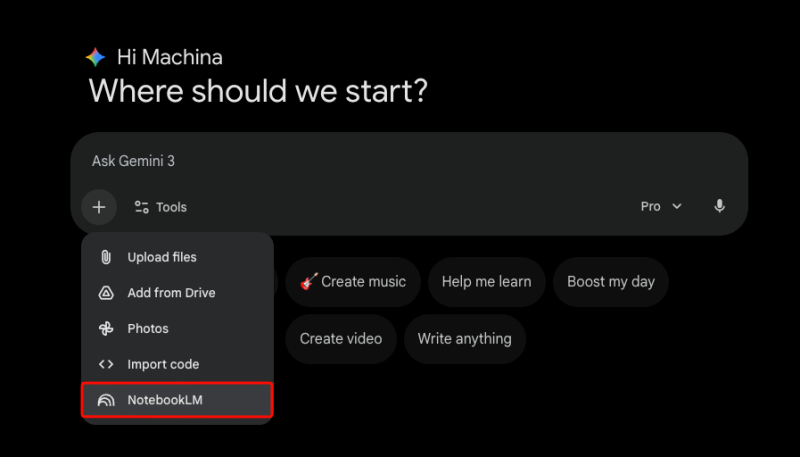
The NotebookLM interface now appears as a built-in tool inside the Gemini environment. Users can upload files, import code, or pull in entire notebooks they've already prepared. Instead of chasing reasoning benchmarks, people are building smarter workflows - using NotebookLM as the knowledge foundation and Gemini as the thinking layer on top.
The model's overall capabilities were covered earlier in GOOGL rolls out Gemini 3.1 Pro with 77.1% ARC-AGI-2 benchmark score, but the real story is how it handles context in practice.
Building Research-Backed Prompts
The process starts with Deep Research inside NotebookLM, which pulls together sources from across the web. Users review and clean up the material, then import the finished notebook straight into Gemini 3.1 Pro. Every prompt after that runs against verified information instead of the model's general training data.
NotebookLM's newer features, like its mind map capability, make organizing large research collections easier. These tools support the shift toward structured knowledge management, as highlighted in Google NotebookLM's mind map feature wins user praise.
Large Context Windows Change the Game
Gemini 3.1 Pro reportedly handles context windows up to around one million tokens. That means entire codebases, book-length documents, or multi-source research bundles can be processed in one session. It's a move away from simple prompts and toward building complete knowledge environments.
This approach mirrors broader trends in AI agent workflows, where separate layers for knowledge storage and reasoning work together - 3 core components driving AI agent workflows in 2024.
What It Means for Professional Users
The pairing of NotebookLM and Gemini 3.1 Pro shows where AI development is heading - toward systems that combine research tools with powerful reasoning engines. As context limits expand and users demand outputs backed by real sources, this type of integration could become standard in research, coding, and analytical work.
 Usman Salis



