
 Usman Salis
⬤ Chinese developers have rolled out AgentScope, a fresh take on building multi-agent AI apps that's catching attention in the developer community. The Python framework is all about agent-oriented programming, letting coders create AI agents that come packed with integrated tools, memory systems, retrieval features, and reasoning capabilities right out of the box. Being fully open source means anyone can jump in and start building without licensing headaches.
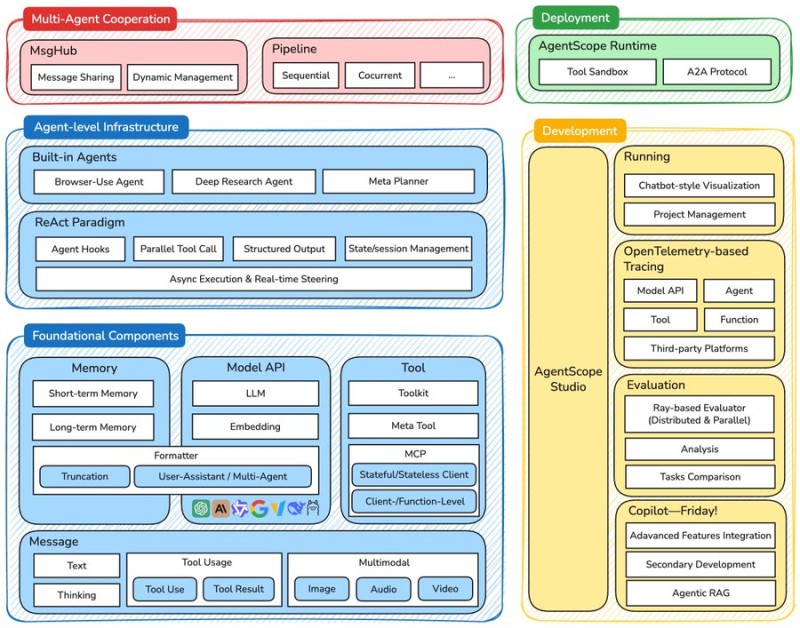
⬤ The framework's architecture breaks down into several smart layers. At the bottom, you've got the essentials—memory management handling both short and long-term recall, model APIs connecting to large language models, and toolkits for various functions. AgentScope handles structured messages across text, tools, and multimodal inputs, so agents can actually talk to each other and coordinate their work instead of operating in silos.
⬤ Moving up the stack, AgentScope brings pre-built agents to the table, including specialized ones for browser tasks and research work, plus a meta planner that orchestrates everything. "The framework is released as fully open source, emphasizing accessibility and flexibility for developers," which explains why it's built to support both sequential and concurrent pipelines with asynchronous execution. The AgentScope Studio component ties it all together with development tools, runtime management, visualization, evaluation features, and OpenTelemetry tracing—basically everything you need to watch your multi-agent system in action.
⬤ Why this matters: Multi-agent AI systems are becoming the next big thing in both research labs and real-world applications. AgentScope lowers the technical barriers that used to make building these systems a nightmare, offering a modular approach that prioritizes scalability and coordination. It's another sign that the AI world is moving away from single-model approaches toward frameworks where multiple specialized agents team up to tackle complex problems.
 Usman Salis



