
 Victoria Bazir
⬤ Recent updates from the Erdős Problems platform reveal a major breakthrough in automated mathematics—artificial intelligence has cracked long-standing open problems without human intervention. Problem #729 fell to GPT-5.2 Pro, illustrating how quickly AI capabilities in rigorous scientific work are advancing.
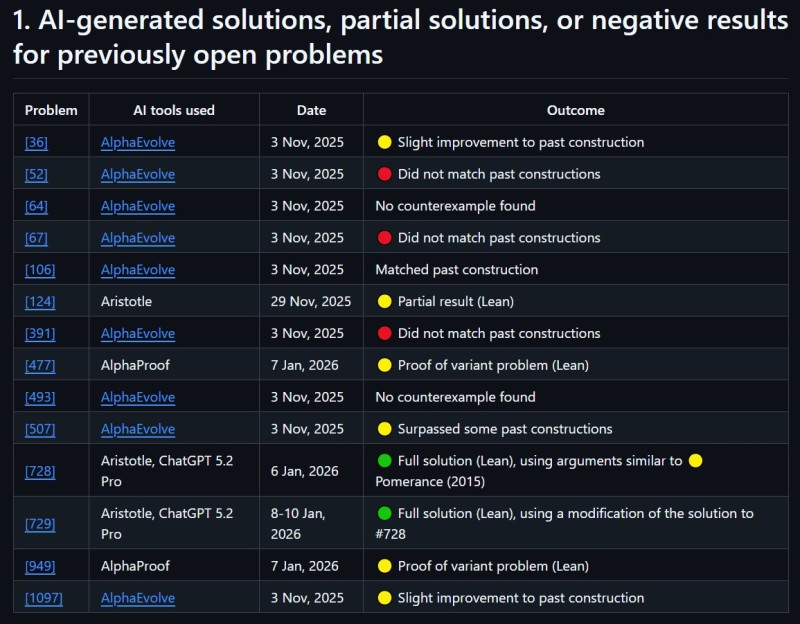
⬤ Documentation shows AI-generated results across numerous Erdős problems, from partial progress to complete solutions. Late 2025 efforts using AlphaEvolve and AlphaProof produced mixed outcomes: some matched existing work, others offered minor improvements or proved related variants, while several problems stayed unsolved or only partially tackled.
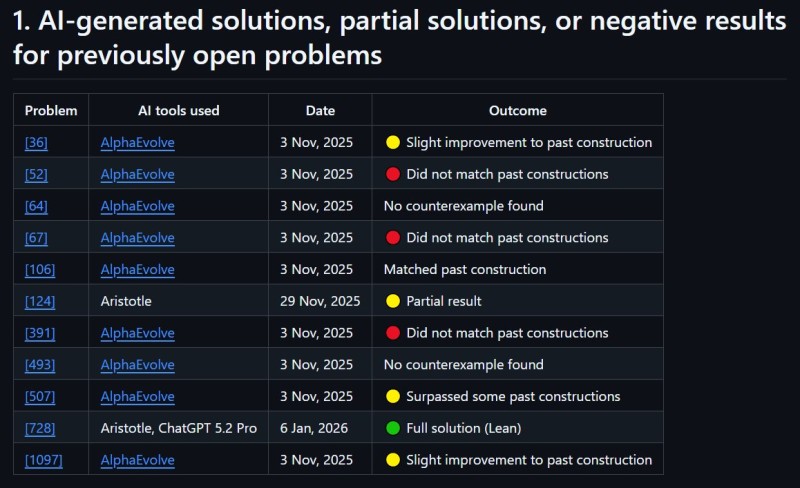
⬤ In early January 2026, GPT-5.2 Pro paired with the Aristotle reasoning system delivered fully autonomous solutions to problems #728 and #729. Both proofs were formalized in the Lean proof assistant, meaning they passed strict verification rather than relying on informal logic. Problem #728 was solved before any human proof existed, while #729 drew on related mathematical literature and remains under review.

⬤ This matters because Erdős problems test the limits of creativity and depth in combinatorics and number theory. AI producing formally verified proofs signals a shift in mathematical research—machines are moving from helpful tools to independent contributors generating rigorously checked discoveries. While interpretation and literature context still require oversight, these results show AI genuinely participating in advanced problem-solving rather than just assisting humans.
 Victoria Bazir



