
 Saad Ullah

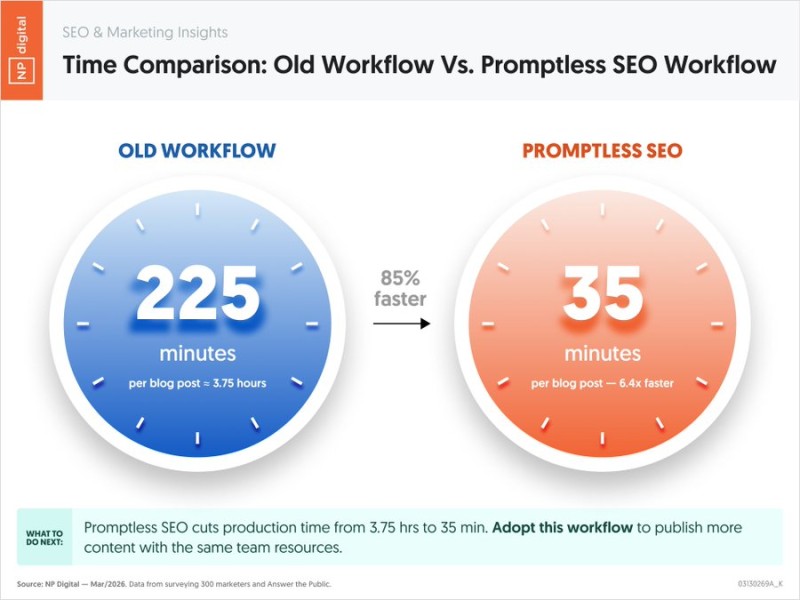
Marketers have long wrestled with the tension between publishing volume and quality. A new dataset changes that calculation dramatically. Writers using AI tools are now producing content up to 6.4 times faster than those relying on traditional workflows - cutting average blog production time from 225 minutes down to 35.
The model behind this shift is called promptless SEO: a more automated pipeline where AI handles research scaffolding, structural drafting, and on-page optimization with minimal manual prompting. The result is an 85% reduction in production time - a figure that is hard to dismiss.
What the 85% Time Reduction Actually Means for Teams
Speed is the headline, but the real opportunity is what happens with the time saved. ChatGPT introduces new group chats in web preview, reflecting how AI platforms are moving deeper into collaborative content workflows. For marketing teams, this means faster iteration cycles, more A/B testing, and room to revisit strategy rather than just execute it.
That framing matters. AI-assisted production can generate volume efficiently, but consistency of quality still depends on how teams use the recovered hours. The tools reduce friction; the judgment remains human.
From Faster Output to Smarter Output: The Next Step
The trajectory of AI capability reinforces this point. Claude Opus 4.6 scores 78.3 on MRCR v2 with 1M token context window, signaling that models are becoming capable of maintaining coherence and depth across far longer content formats. For publishers, this opens the door to long-form research, multi-part series, and deeply structured editorial output - not just faster blog posts.
The broader shift is clear: AI is not replacing editorial teams but restructuring how they spend their time. As adoption scales, the competitive advantage will belong to organizations that treat AI as a strategic lever - not a shortcut, but a way to do more of the work that actually matters.
 Saad Ullah



