
 Sergey Diakov
⬤ A timeline of large language model development in 2025 reveals a sequence of major releases across the AI sector. Early in the year, DeepSeek R1 proved that open-source reasoning systems could hit top-tier performance without massive training budgets. This kicked off a year of rapid advances across AI platforms, with the industry—including companies tied to Microsoft (NASDAQ: MSFT)—continuing to move fast.
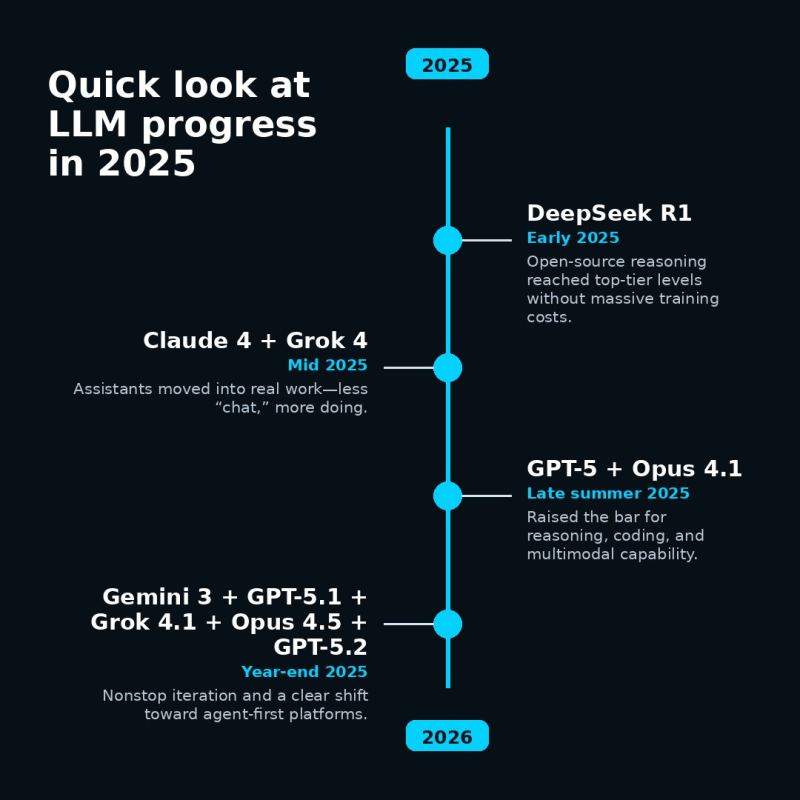
⬤ By mid-2025, Claude 4 and Grok 4 pushed AI assistants beyond simple chat toward handling actual operational tasks. The shift emphasized "less chat, more doing," marking a clear move toward systems that execute tasks and support real workflows. Later that summer, GPT-5 and Opus 4.1 raised the bar for reasoning, coding and multimodal capabilities, delivering another leap forward in what these models could handle.
⬤ The final stage of 2025's progression brought continuous iteration through year-end, with releases including Gemini 3, GPT-5.1, Grok 4.1, Opus 4.5 and GPT-5.2. These developments pointed to nonstop product cycles and a broader industry pivot toward "agent-first" AI platforms—systems built not just to answer questions, but to take action, plan ahead and operate across multiple tools and environments.
⬤ This sequence of milestones shows just how quickly the AI landscape is advancing, with increasingly capable models and growing focus on agent-style systems. The timeline suggests that ongoing innovation—including work connected to MSFT—keeps expanding AI's role in automation, reasoning and real-world applications as the market moves toward 2026.
 Sergey Diakov



