Saad Ullah

⬤ Stanford HAI launched the 2025 Global AI Vibrancy Tool, a framework that measures national AI ecosystems across 36 countries. The updated index uses improved data sources and expanded metrics to assess how nations prioritize AI development. The ranking positions the United States at the top, China second, and India third, based on 42 indicators across eight categories: research output, responsible AI practices, economic activity, talent pools, governance structures, public sentiment, and infrastructure.
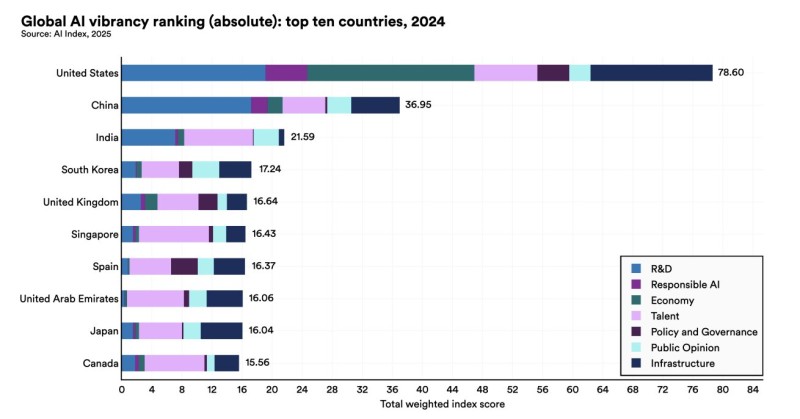
⬤ The data reveals the United States scored 78.60 in absolute rankings, significantly ahead of China's 36.95 and India's 21.59. Each nation shows distinct advantages: the US dominates in investment, infrastructure, and R&D; China leads in patents and academic publications; India demonstrates rapid growth in talent and economic expansion. The remaining top ten includes South Korea (17.24), the United Kingdom (16.64), Singapore (16.43), Spain (16.37), the United Arab Emirates (16.06), Japan (16.04), and Canada (15.56), showing how AI capabilities vary globally.
⬤ The tool's methodology applies min-max normalization to convert raw data into a 0–100 scale and uses weighted averages for pillar-level scores. Data comes from CSET for research metrics, QUID for investment tracking, LinkedIn for talent analysis, plus Epoch AI, GitHub, and the Top500 compute rankings. The framework includes sub-indices for Innovation, Economic Competitiveness, and Policy and Governance, letting analysts customize weights for specific priorities. Per capita rankings show different leaders: Luxembourg (46.84), Singapore (43.72), and the United States (27.29).
⬤ The findings show how nations compete in the global AI race. The growing gap between the US and China reflects different national strengths, while India's climb signals stronger focus on talent and economic scaling. As organizations work to understand their competitive position, the AI Vibrancy Index offers a clear framework for tracking advancement, spotting gaps, and analyzing how worldwide AI strategies develop.
 Saad Ullah