
 Usman Salis
⬤ SpaceX has tightened its grip on the global launch market. Between January 1 and March 23, 2026, the company completed 37 orbital launches, capturing 58% of all global launch activity. That number alone exceeds every other launch provider in the world combined, a gap that keeps growing year over year.
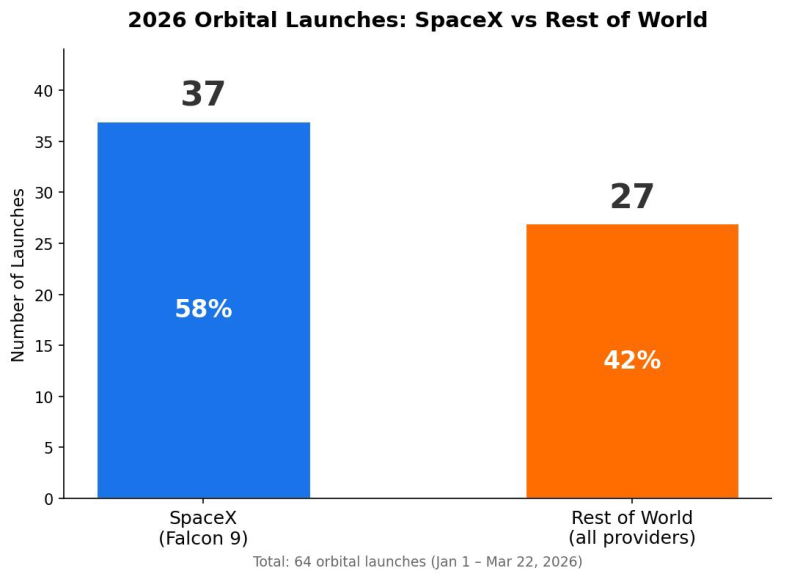
⬤ The rest of the world managed 27 launches over the same stretch, or 42% of a 64-mission global total. SpaceX recorded zero failures across its Falcon 9 fleet, while competitors across China, Japan, and India absorbed four failures between them. Falcon 9 posted a 100% success rate through all of 2025, and that streak has carried straight into 2026. The company is now pushing those capabilities further, with plans for a 100 GW solar satellite system designed to power AI infrastructure from orbit.
Reusability isn't just an engineering achievement. It's what makes launching at this frequency economically possib
⬤ Behind the volume sits SpaceX's reusable rocket model. Rapid booster turnaround cuts the time and cost between launches, letting the company sustain a cadence traditional providers simply cannot match. That same operational infrastructure is converging with AI ambitions on the ground, where Tesla and SpaceX's Terafab chip factory is targeting one terawatt of compute capacity.
⬤ The structural gap in launch performance is reshaping global space access. As SpaceX pulls further ahead on both volume and reliability, the competitive dynamics of the industry are shifting in ways that carry real geopolitical weight. That pressure extends beyond rockets: OpenAI has warned Congress that China is closing the AI gap rapidly, adding another dimension to the broader tech race playing out across space, chips, and software.
 Usman Salis



