
 Saad Ullah

⬤ As Rohan Paul reported, Google revealed how Gemini Deep Think tackles open-ended research problems instead of just contest-style math challenges. The company unveiled Aletheia, an agent that drafts, checks, and fixes mathematical proofs using an iterative reasoning approach.
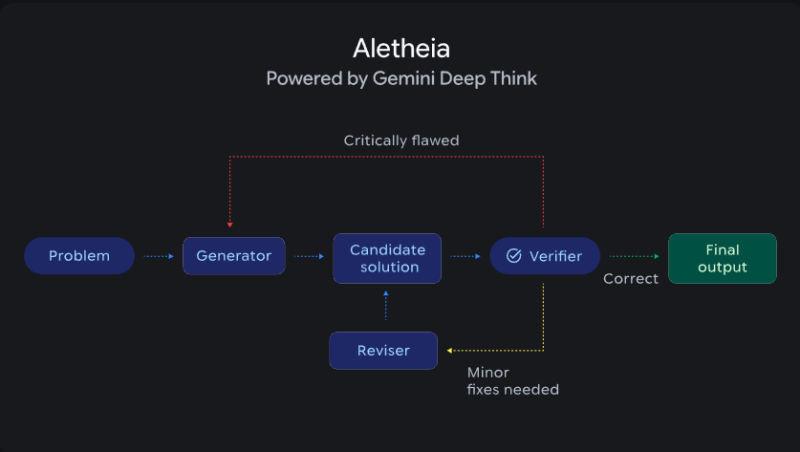
⬤ Aletheia works through a generator-verifier-reviser cycle. It evaluates proof drafts in natural language, patches them if they're nearly correct, or starts fresh when they're fundamentally flawed. The workflow moves from problem to generator, then to candidate solution, verifier, and final output, with a reviser fixing any issues along the way. Google reported the system hits around 90% on the IMO-ProofBench Advanced benchmark.
⬤ Earlier language models often nailed the final answer but left reasoning gaps or made up references. To fix this, Gemini Deep Think can search the web to back up claims with published research during lengthy derivations. Google noted that since reaching IMO gold-medal-level performance in July 2025, the model has improved further as inference-time compute scales, with gains partially carrying over to tougher research problems in its internal FutureMath Basic set. The system has also tackled large collections of open Erdős-style problems spanning optimization, economics, and physics.
⬤ This update highlights an AI strategy centered on verifying and repairing reasoning rather than just generating answers. Such systems could serve as tools for checking proofs and spotting counterexamples, though human oversight remains essential.
 Saad Ullah



