
 Marina Lyubimova

Mergers and acquisitions have always been brutal on analysts. The due diligence phase alone can stretch across weeks of late nights spent scanning virtual data rooms, extracting contract clauses, and cross-referencing financial databases. But that grind is starting to look like a relic. AI-powered tools are now handling much of that work in minutes, not hours, and the corporate finance world is paying close attention.
From 500-Hour Homework to Automated Workflows
The traditional "500-hour" M&A homework is being replaced by AI workflows capable of scanning entire data rooms, flagging red flags, and surfacing buried liabilities without a single analyst losing sleep over it. The shift is visible across six core areas: external benchmark aggregation, due diligence, sentiment analysis, valuation modeling, document processing, and investment material generation.
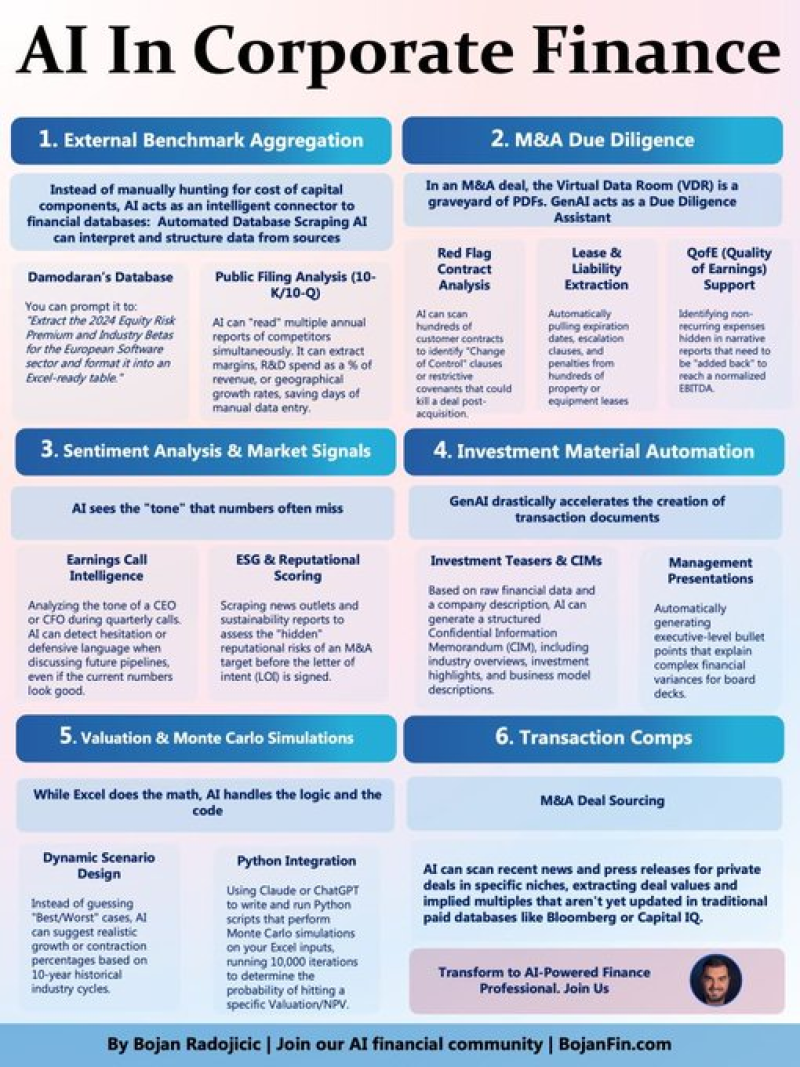
Instead of manually pulling cost-of-capital components, automation now connects directly to financial databases and structures the data on demand. In due diligence, AI tools identify quality-of-earnings issues often buried deep in lengthy agreements. Sentiment analysis reads tone in earnings calls. Valuation workflows run dynamic Monte Carlo simulations or plug into Python environments for complex scenario modeling. And investment materials like confidential information memoranda or investor teasers? Those can be drafted automatically, too.
AI does not just make existing models faster - it enables professionals to focus on strategy and decision-making rather than paperwork.
On the infrastructure side, Lindy AI's always-on assistant shows how this kind of persistent automation is expanding across enterprise workflows, including finance. Meanwhile, tools backed by NVDA hardware are delivering the compute muscle needed to power document processing at scale.
A Structural Shift, Not Just a Speed Boost
This isn't about doing the same things faster. It's a structural change in how deals get done. When AI handles the data extraction and pattern recognition, bankers and analysts can spend their time on what actually moves a transaction forward: negotiation, strategy, and judgment calls that no algorithm can replicate.
That said, the broader implications for the workforce are real. AI automation is already raising unemployment risks for recent graduates, with an estimated 300 million jobs potentially affected globally. The finance sector won't be immune. Entry-level roles that once served as training grounds for analysts may shrink as AI absorbs the repetitive work.
At the same time, capable AI agents are getting better fast. GPT-5's agent recently hit a 72.6% success rate on the OSWorld automation benchmark, a signal of how quickly these systems are maturing. In corporate finance, where speed, accuracy, and depth all matter, that trajectory points toward AI becoming less of a tool and more of a standard operating requirement.
 Marina Lyubimova



