
 Peter Smith
⬤ OpenAI's GPT-5.4 model family is out, and the mini variant is already making noise. Focused on speed and cost efficiency, GPT-5.4 mini delivers results that rival much heavier systems. It scores 54.4% on SWE-Bench Pro and 60.0% on Terminal-Bench 2.0, sitting just behind the flagship GPT-5.4. The release signals a wider shift: smaller models are becoming capable enough to handle serious workloads.
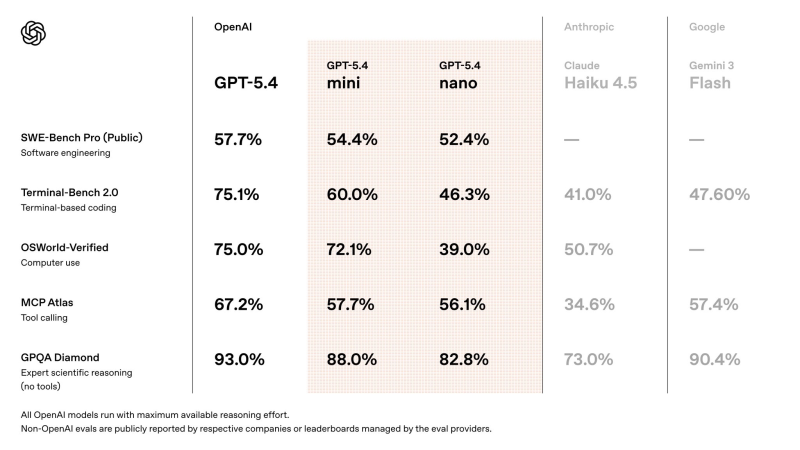
⬤ The competitive picture is telling. GPT-5.4 mini achieves 72.1% on OSWorld-Verified, clearly ahead of Anthropic's Claude Haiku 4.5 at 50.7%. On tool-calling benchmarks, it holds its ground with 57.7% on MCP Atlas, while the full GPT-5.4 leads the field with 75.1% on Terminal-Bench and 93.0% on GPQA Diamond, confirming its position as a top-tier reasoning model.
⬤ Even GPT-5.4 nano, the lightest model in the family, punches above its weight with 52.4% on SWE-Bench Pro and 82.8% on GPQA Diamond. The gap between compact and large models is narrowing fast. OpenAI's focus on resource-efficient architecture is paying off, with newer models designed to match larger systems while cutting computational costs.
⬤ The broader takeaway is a reshaping of the AI market. Efficiency-driven models are no longer just budget options; they are becoming serious contenders for real-world deployments. As GPT-5.4 mini's benchmark numbers show, performance and practicality are converging, accelerating competition among major AI providers and changing how teams integrate AI into their daily workflows.
 Peter Smith



