
 Usman Salis
⬤ Recent benchmarking data shows a clear performance gap emerging between top AI labs. OpenAI, Google, and Anthropic have all posted strong gains from 2022 through 2025, with each year bringing steep improvements in model capability. The data reveals that earlier systems like GPT-4 had limited success with autonomous workflows, but newer releases represent a significant jump forward in how well these models handle complex, multi-step tasks.
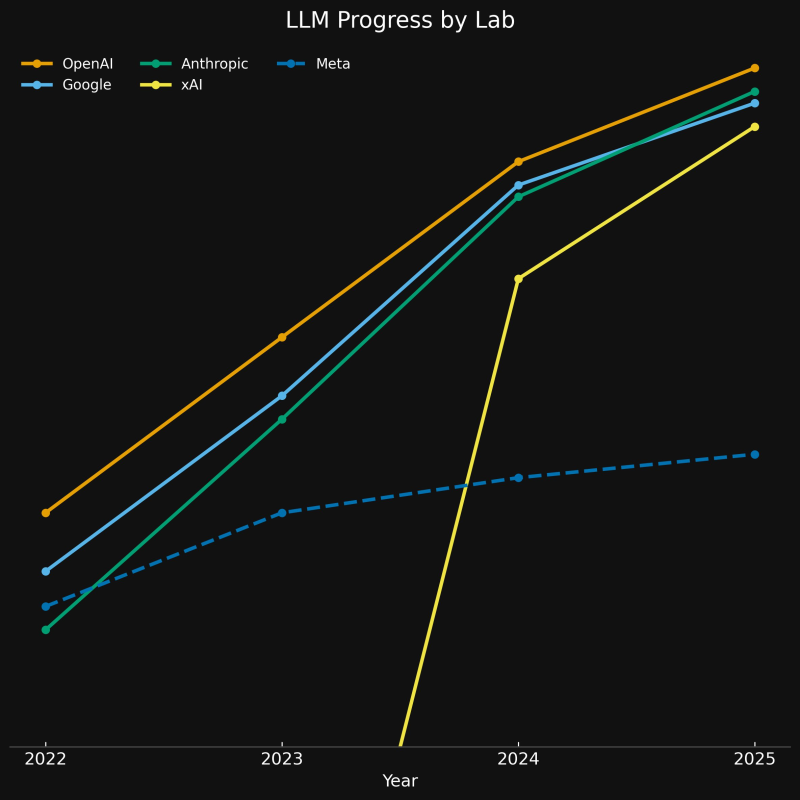
⬤ OpenAI continues leading the pack, showing consistent advancement between 2023 and 2025. Google and Anthropic are tracking similar growth patterns, narrowing earlier gaps and building competitive momentum. Meta's trajectory looks notably flatter, suggesting its LLM development may be losing steam. Meanwhile, xAI demonstrated sharp acceleration between 2023 and 2024, climbing quickly from a modest starting point.
⬤ Autonomy is becoming the crucial differentiator. Where GPT-4 struggled to maintain extended workflows, newer models like GPT-5.1-codex-max can reportedly handle agentic tasks running for hours. This represents more than just incremental progress—it's a fundamental shift in operational independence and problem-solving capability. The performance gains shown by OpenAI, Google, and Anthropic align directly with this evolution toward true autonomous AI systems.
⬤ These diverging paths could reshape the entire AI landscape. The rapid advancement from OpenAI, Google, and Anthropic strengthens their market position, while Meta's slower pace creates a strategic gap. This performance split will likely influence where investment flows, which partnerships form, and ultimately how fast AI capabilities advance across the industry.
 Usman Salis



