
 Usman Salis

⬤ vLLM-Omni v0.14.0 has just landed, and here's the thing — this is the project's first ever stable release meant for real-world production use. The update packs 180 commits from more than 70 contributors, with 23 brand new contributors jumping in. What makes this one stand out is the unified support for text, image, audio, and video workloads, all baked into a single platform.
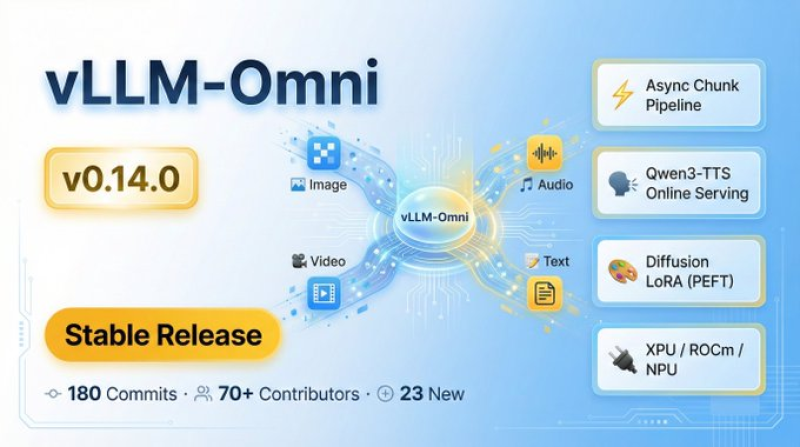
⬤ On the infrastructure side, the release brings some solid performance upgrades. There's a new asynchronous chunk pipeline built to improve execution overlap, online serving support for Qwen3-TTS, and Diffusion LoRA compatibility via PEFT. Hardware support got a nice boost too — XPU, ROCm, and NPU backends are now in the mix, which really cements vLLM-Omni's reputation as a hardware-agnostic inference framework.
⬤ The model lineup got a meaningful expansion as well. Bagel with its multi-stage pipeline, Stable Audio Open, and image models like GLM-Image, FLUX.1-dev, and FLUX.2-klein are all newly supported. The API side adds a /v1/images/edit endpoint plus health and model listing endpoints for diffusion mode. Performance-wise, expect gains from Torch compile for diffusion, SharedFusedMoE for Qwen3-Omni, TeaCache integration, and sequence parallelism for diffusion workloads.

⬤ This stable release is a clear sign that production-grade multimodal inference is no longer a niche concern. Open-source AI infrastructure is moving fast, and vLLM-Omni is right at the front of that curve — proving that unified, flexible inference frameworks are exactly what the industry needs as AI workloads get more complex.
 Usman Salis



