
 Eseandre Mordi
A fresh wave of speculation is sweeping through the AI world as developers examine what looks like a leaked internal code reference to "GPT-5.1 Thinking." While OpenAI hasn't confirmed anything, the appearance of these identifiers in a circulating screenshot has sparked heated discussion about the next stage of reasoning-focused AI models.
GPT-5.1 "Thinking Mode" Leak Raises Major Questions
AI commentator Lisan al Gaib recently highlighted what appears to be a leaked code snippet referencing both "gpt-5-thinking" and "gpt-5.1-thinking" within a JavaScript module. The file includes model identifiers and telemetry tracking for "ChatGPT Composer Thinking Effort," suggesting internal instrumentation related to reasoning workloads.
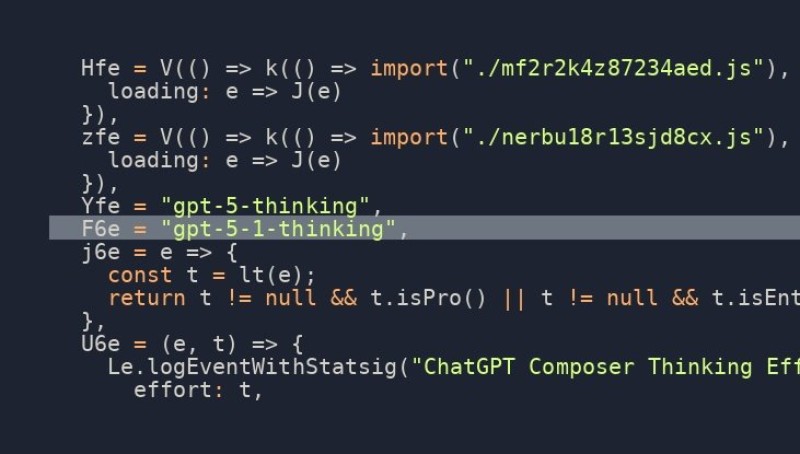
Although nobody has verified the file's authenticity, the presence of versioned "thinking modes" has fueled speculation that OpenAI may be preparing a new reasoning-enhanced model. The code also checks for Pro user status before enabling specific features, implying that certain reasoning modes may be gated behind subscription tiers.
Context: The Industry's Race Toward Deep Reasoning Models
Over the past year, AI labs have shifted aggressively toward models capable of multi-step reasoning and higher factual accuracy. Google, Anthropic, Meta, and OpenAI are all developing "slow thinking" or "deliberate reasoning" modes. The presence of "GPT-5.1 Thinking" in development code, if real, would place OpenAI firmly in that competitive space.
Could GPT-5.1 Be the Next Major Model?
There are several possibilities. It could represent a true next-generation model with a staged GPT-5 rollout, or OpenAI may be testing deeper reasoning pipelines on existing models. This could also be a feature flag for longer deliberation, similar to GPT-4's "slow mode," or simply a temporary placeholder that never reaches production.
Community Reaction: Excitement Meets Skepticism
The response across Reddit, Twitter, and AI forums has been divided. Excited users see this as early proof that GPT-5-level models are getting close, while skeptics argue the code could be old or misinterpreted. Regardless, the conversation highlights how eagerly the AI community is awaiting the next leap in reasoning capability.
 Eseandre Mordi



