
 Marina Lyubimova

⬤ A Multi-Agent Framework for Autonomous Organizations. A newly published research paper from Isotopes AI introduces a structured approach to building fully autonomous companies that operate without human involvement. The paper, titled "If You Want Coherence, Orchestrate a Team of Rivals: Multi-Agent Models of Organizational Intelligence," makes the case that true organizational intelligence comes from coordinating multiple specialized AI agents rather than depending on a single all-purpose model. The framework uses a finite-state, multi-agent architecture with clearly separated execution phases and control layers.
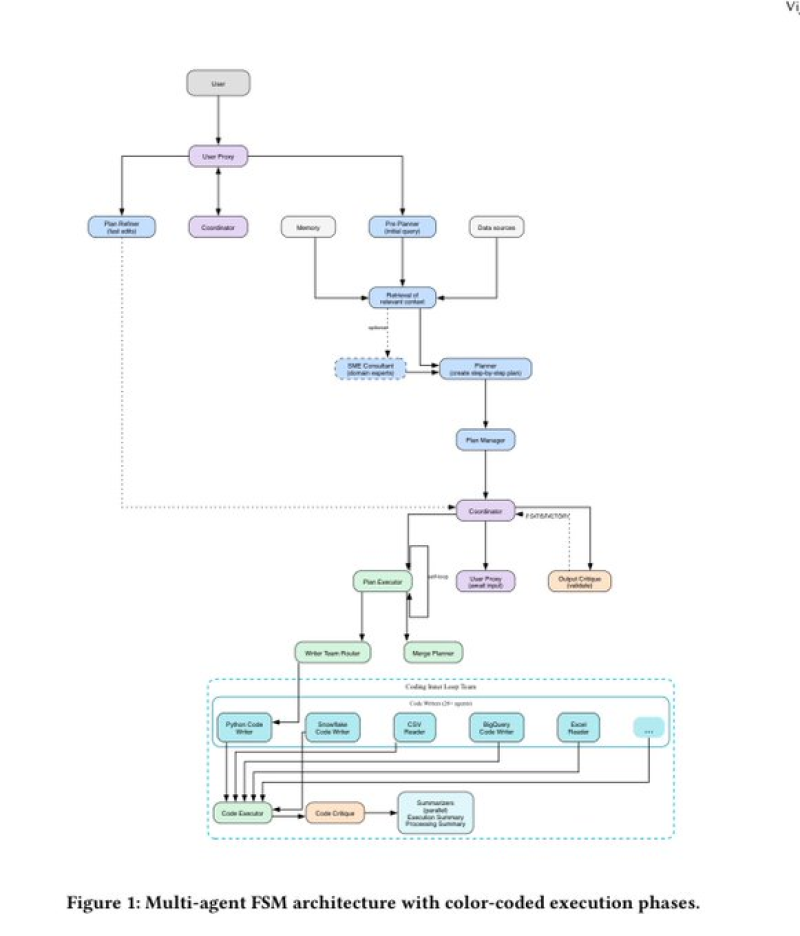
⬤ Why Single-Agent Systems Fall Short. Single-agent AI systems face serious limitations when one large language model tries to handle planning, execution, reasoning, and self-evaluation all at once. This design creates several problems: context contamination, unchecked hallucinations, fragile execution paths, and poor auditability. The proposed architecture takes a different approach by assigning distinct roles to different agents—planners, executors, critics, coordinators, and domain experts—each working within defined boundaries. Critics function as adversarial reviewers with veto power, which helps prevent errors from spreading through the system.
Organizational intelligence can be achieved by coordinating multiple specialized AI agents rather than relying on a single, all-purpose model.
⬤ Data Isolation and Hierarchical Safeguards. The framework maintains strict separation between data and execution. Raw data and computations are processed outside the language model context by dedicated execution environments, while agents communicate through structured summaries and schemas. This separation keeps the system grounded and prevents unintended feedback loops. The architecture also includes multiple layers of protection: checkpoints, escalation paths, fallback mechanisms, and session-level logging. Every action and decision gets recorded, making it possible to trace what happened even if the original data changes.
⬤ The Path to Zero-Human Companies. This "team of rivals" model serves as a practical foundation for companies that run autonomously without constant human oversight. When systems operate independently at scale, reliability, resilience, and auditability become essential rather than optional. By focusing on organizational structure instead of just making models bigger, the research points toward collective AI systems that work like real corporate checks and balances. This marks a shift toward structured autonomy as AI systems increasingly take on high-stakes operational responsibilities.
 Marina Lyubimova



