
 Eseandre Mordi
⬤ A recent U.S. survey of 2,301 American adults conducted from August 1–6, 2025 shows the country is nearly split down the middle on AI's future impact. People can't agree on whether artificial intelligence will make life better, worse, or if it's just too early to tell. The survey, published by the Searchlight Institute, reveals this uncertainty extends to how people rank AI against other game-changing technologies from history.
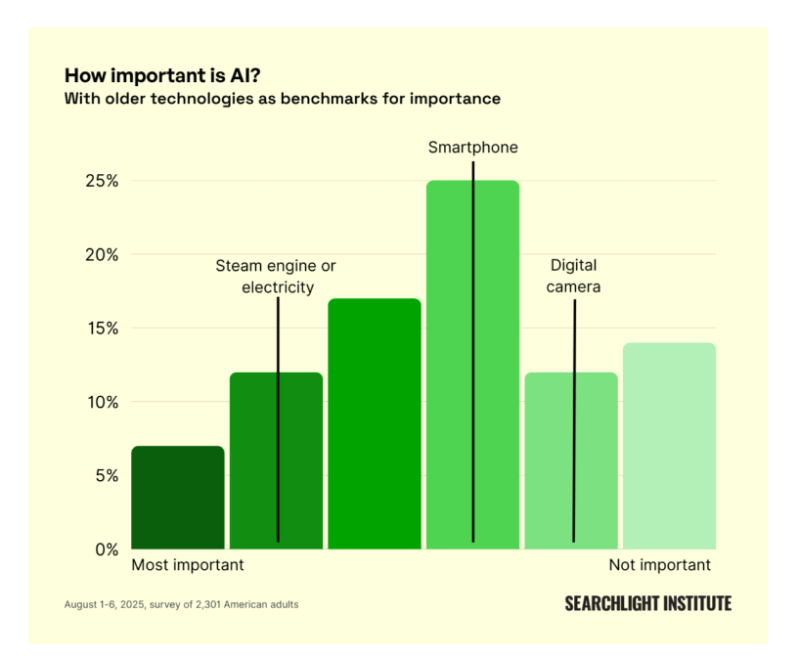
⬤ When asked to compare AI's importance to past innovations, most respondents put it on par with the smartphone—a technology that completely changed how we communicate and live. A significant number went further, comparing AI to revolutionary breakthroughs like the steam engine or electricity. Others saw it more like the digital camera—useful but not world-altering. A smaller group dismissed AI as "not important" altogether. These mixed reactions mirror the broader split in public sentiment: excitement and worry are sharing the stage.
⬤ AI isn't theoretical anymore. It's already embedded in the apps we use, the services we rely on, and the infrastructure running behind the scenes. From automation and data crunching to machine learning tools popping up everywhere, AI development is moving fast. But even with all that momentum, Americans haven't made up their minds about what it means for society in the long run.
⬤ Public opinion matters here because it influences how quickly AI gets adopted, how governments regulate it, and what people expect from these technologies as they continue to evolve. With the country still divided 50/50 on AI's impact, expect policy debates, business strategies, and investment decisions to keep shifting as both optimism and uncertainty shape the road ahead.
 Eseandre Mordi



