
 Eseandre Mordi
⬤ 2025 was the year AI stopped being just a chatbot. Major platforms like Alphabet (GOOGL) and OpenAI pushed reasoning-focused models into real-world deployment, with their systems hitting gold-medal performance at the International Olympiad in Informatics and the International Mathematical Olympiad. Meanwhile, AI agents, "AI browsers," and tools built for long-running tasks became the new product focus—moving away from simple conversations toward systems that actually get work done.
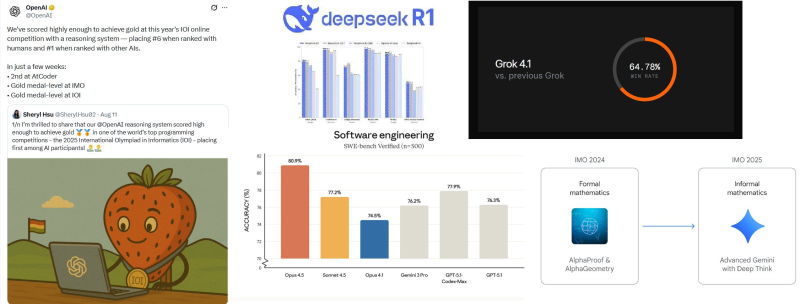
⬤ The year kicked off with DeepSeek R1, an open-source reasoning model that sparked a competitive wave across the industry. OpenAI followed with Operator, a research preview showing an AI agent that could navigate and interact with websites. Alphabet (GOOGL) upgraded Gemini with models designed for structured reasoning and task execution, while Anthropic expanded Claude with versions built for deeper, longer problem-solving. Throughout the year, releases like GPT-5, Gemini 3, Claude 4, Opus 4.5, and Grok 4 kept pushing performance higher on reasoning and coding benchmarks.
⬤ Other notable moments included Perplexity launching its Comet AI browser, OpenAI rolling out ChatGPT agent capabilities, and steady gains in code accuracy and task endurance. The gold-level Olympiad results from both OpenAI and Google teams marked a cultural shift—AI systems were now matching or beating top human competitors in highly specialized domains.
⬤ The big shift in 2025 wasn't just about smarter models—it was about AI moving from conversation to execution. Companies like Alphabet (GOOGL) and OpenAI are now competing on reliability, sustained task performance, and integration with actual workflows. As 2026 approaches, the conversation is turning toward infrastructure scaling, power and compute resources, system security, and governance frameworks as AI embeds itself deeper into business operations, research, and automation.
 Eseandre Mordi



