
 Eseandre Mordi
⬤ A 2009 forecast predicting artificial general intelligence has resurfaced, sparking fresh conversations about AGI timelines. DeepMind co-founder Shane Legg published a probabilistic estimate back then, with the most likely outcome clustering around the mid-2020s and the expected value landing closer to 2028. The chart that accompanied his forecast doesn't pinpoint a single date—instead, it maps out how AGI probability builds over time.
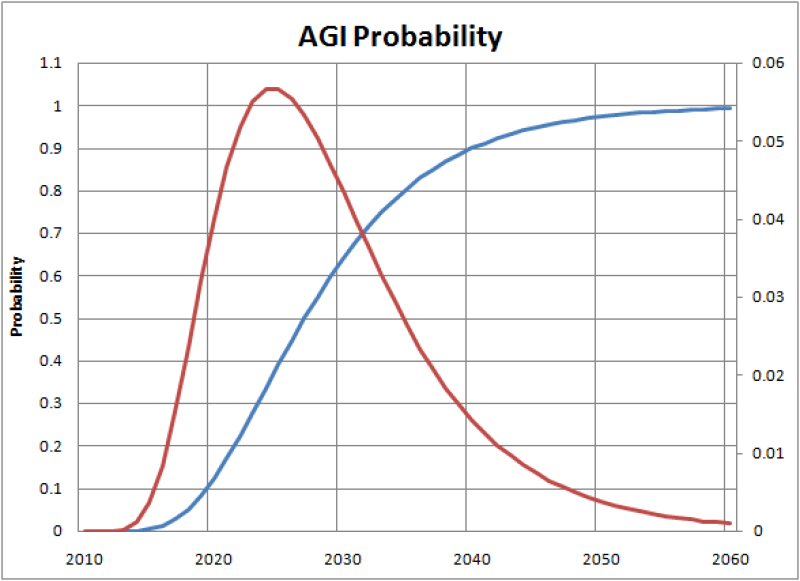
⬤ The probability curve starts close to zero in the early 2010s, then climbs gradually through the late 2010s before shooting up after 2020. By the late 2020s, it crosses the 50% mark and keeps rising into the 2030s and beyond. There's also a second curve showing the distribution of expectations—it peaks earlier and then drops off, capturing the difference between the most likely timing and the average expected outcome. This lines up perfectly with Legg's explanation: while the mode sat near 2025, the expected value shifted to around 2028.
⬤ What makes this forecast stand out is when it was made. In 2009, we didn't have large-scale deep learning, foundation models, or today's multimodal systems. Compute power, data availability, and training methods were nowhere near current levels. Even with those limitations, the chart shows an effort to quantify uncertainty through probabilistic reasoning instead of just picking a fixed date. Legg also pointed out that even if human-level AI showed up, skepticism would likely stick around—which is why the probability curve slopes up gradually rather than spiking overnight.
⬤ Long-term AGI predictions shape how we think about technology development across research, industry, and policy. Looking back at early probabilistic forecasts shows how foundational assumptions have influenced today's debates and why the late 2020s keep coming up as a pivotal timeframe. The chart makes it clear: uncertainty has always been at the heart of serious AGI timeline modeling.
 Eseandre Mordi



