
 Eseandre Mordi

⬤ MiniMax launched its open-source M2.1 coding model built specifically for real-world software development across multiple programming languages. The model crushed Claude Sonnet 4.5 and Gemini 3 Pro on multilingual coding benchmarks, posting a 72.5% on SWE-bench Multilingual and an impressive 88.6% on the company's own VIBE full-stack benchmark.
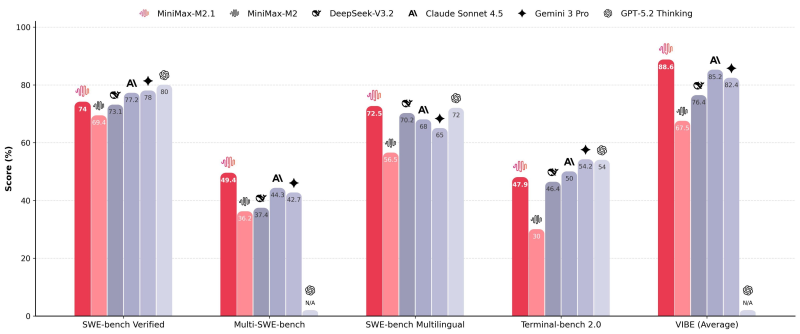
⬤ Beyond those headline numbers, M2.1 hit 74% on SWE-bench Verified, 49.4% on Multi-SWE-bench, and 47.9% on Terminal-bench 2.0, putting it right up there with the top coding AI models. What makes this different is the focus on practical coding across languages like Rust, Java, Go, C++, Kotlin, TypeScript, and JavaScript, not just Python. This positions it as a serious tool for full-stack developers working in multilingual environments.
⬤ MiniMax tested the model through its Agent platform, where users can describe what they want to build and the system generates it without needing API keys or complicated setup. The company showcased three actual project builds to prove the model works in real-world scenarios, not just theoretical benchmarks.
⬤ The open-source release of MiniMax M2.1 shows how fast AI coding tools are evolving and heats up competition among major AI models. With benchmark scores edging out Claude Sonnet 4.5 and Gemini 3 Pro in multilingual categories, this release signals real progress in multi-language coding capabilities and adds another development to watch in the AI-driven tech landscape that continues shaping global markets.
 Eseandre Mordi



