
 Usman Salis
⬤ Forecasters keep moving the expected arrival date of artificial general intelligence. In 2019 they placed it about eighty years ahead. Breakthroughs since then have forced them to tear up those schedules. A new chart shows how each advance in language models and conversational systems has compressed the expected wait.
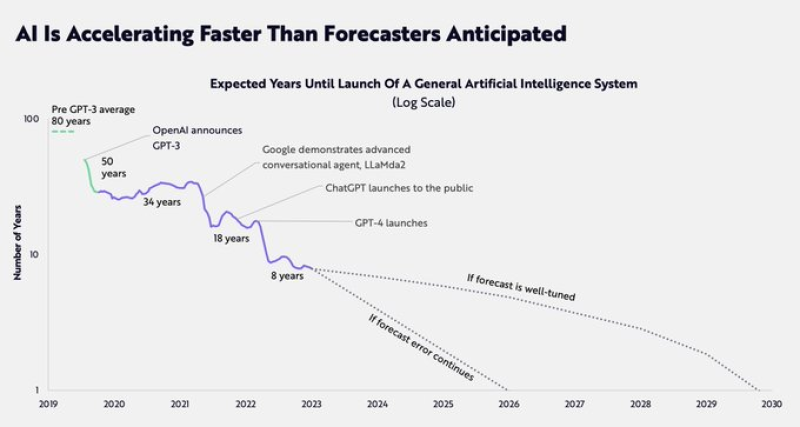
⬤ The data link each revision to a specific product release. After GPT-3 appeared, the horizon shrank from roughly fifty years to the mid thirties. Google's advanced conversational agents plus the public launch of ChatGPT pushed it lower still. By the time GPT-4 arrived, some forecasts placed AGI fewer than ten years away - an acceleration that caught most predictors by surprise.
Since 2019 we have gained multimodal models, better reasoning and agents that wield tools. Those developments overturn earlier beliefs about how long general purpose AI would take.
⬤ The visualization sketches two futures. In the first forecasters finally stop revising but also the line flattens. In the second AI keeps beating expectations and the line keeps dropping. Which path wins will strongly influence the actual arrival date.

⬤ The stakes are high because improvement is no longer gradual - it is a sharp speed up. Shorter timelines force companies, governments as well as institutions to confront readiness and governance far earlier than they had scheduled. The chart does not claim that AGI exists today - yet it shows the distance between current AI or full generality is closing faster than almost anyone thought possible a few years ago.
 Usman Salis



