
 Eseandre Mordi

⬤ xAI has rolled out the Grok Collections API, marketing it as a next-level retrieval-augmented generation system that's baked directly into their platform. Users can now upload entire datasets—PDFs, Excel files, complete codebases—and search through them without setting up a separate indexing infrastructure. It's designed to tackle both structured and unstructured data at scale, making it practical for real-world applications that need to handle serious document volumes.
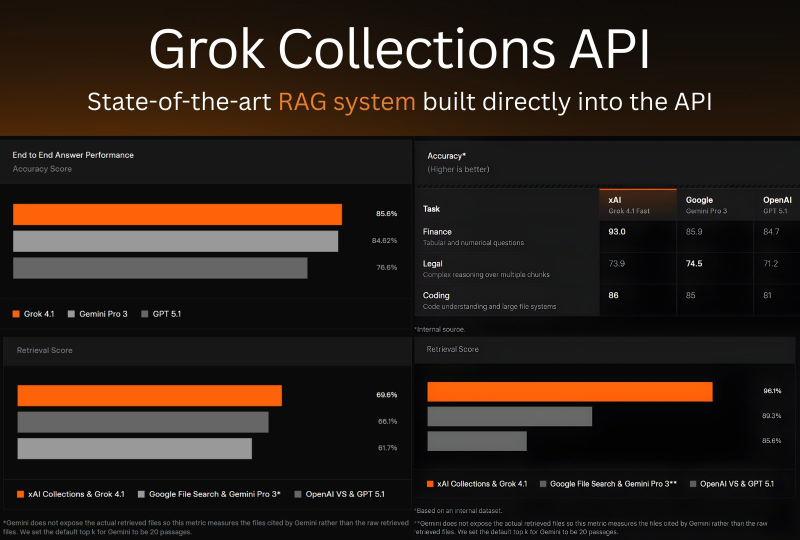
⬤ The system handles file uploads automatically and keeps everything updated as your data changes, with reindexing happening behind the scenes. It's built for heavy-duty scenarios in finance, legal research, and software development where pulling the right information matters. xAI is sweetening the deal with a free first week of indexing and storage, then charging $2.50 per 1,000 searches after that—a clear play for accessibility before the usage costs kick in.
⬤ Internal benchmarks show Grok Collections beating both Google's Gemini 3 Pro and OpenAI's GPT-5.1 on core retrieval tasks. The testing focused on end-to-end answer accuracy and retrieval precision, particularly in finance, legal, and coding contexts. These metrics matter because they measure how well the system actually finds the right information in documents during searches—the key to cutting down errors and hallucinations in RAG applications.
⬤ This launch signals the growing push for RAG solutions that companies can deploy quickly without heavy lifting. Strong retrieval combined with streamlined data management could drive faster adoption across knowledge bases, research platforms, support systems, and compliance workflows. As AI providers battle for market share, releases like Grok Collections show that retrieval quality and ease of use are becoming the real competitive edge in enterprise AI.
 Eseandre Mordi



