
 Eseandre Mordi
⬤Researchers have unveiled InternGeometry, a large language model agent built specifically to crack Olympiad-level geometry problems. The system managed to solve 44 out of 50 International Math Olympiad geometry challenges—a success rate that actually surpasses what most human gold medalists achieve. The agent works through an iterative reasoning process, using dynamic memory and structured feedback loops to tackle each problem step by step.
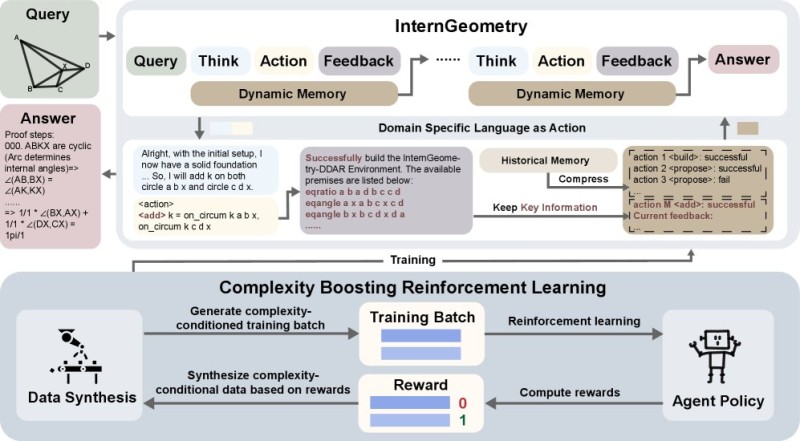
⬤What makes InternGeometry particularly impressive is that it reached this level with only about 13,000 training examples—a fraction of what most advanced mathematical AI systems typically need. The architecture converts geometric reasoning into specific actions using a specialized domain language. These actions get evaluated, stored, and refined through dynamic memory, which lets the model build multi-step proofs instead of just matching patterns it's seen before.
⬤The secret sauce behind InternGeometry's success is something called Complexity-Boosting Reinforcement Learning. This approach adjusts training difficulty based on how well the agent is performing. The system calculates rewards from successful reasoning attempts and uses them to create increasingly complex training scenarios. This progressive training method allows InternGeometry to handle tougher geometry problems while staying efficient. The agent also compresses its historical memory, keeping the essential reasoning steps without getting bogged down by too much information.

⬤This breakthrough matters because it shows how combining structured reasoning, smart memory management, and reinforcement learning can dramatically boost AI's ability to solve formal mathematics problems. By cracking most Olympiad-level geometry challenges with relatively little training data, InternGeometry points toward a new direction for building more general reasoning systems that could handle advanced scientific, educational, and symbolic tasks. The takeaway here is that future AI advances might depend less on simply throwing more data at the problem and more on clever architecture design, better reasoning structures, and adaptive learning methods.
 Eseandre Mordi



