
 Saad Ullah

⬤ Google's Gemini 3 Flash just proved it can handle some seriously challenging handwriting. The model successfully transcribed handwritten notes from Nobel Prize winner Richard Feynman, specifically a letter related to the Space Shuttle Challenger investigation from February 6, 1986. We're talking multiple pages of tight cursive, overlapping lines, and packed text—exactly the kind of stuff that usually gives OCR systems nightmares.
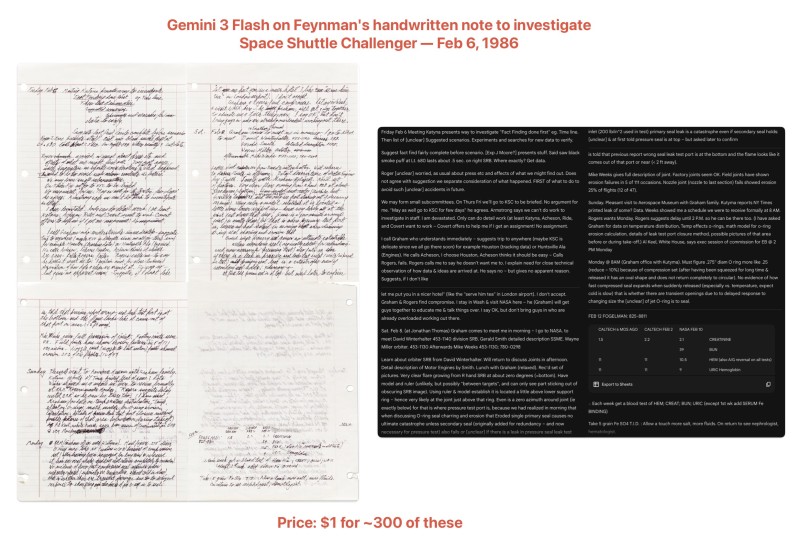
⬤ What's impressive is how the model handles accuracy without overthinking things. Gemini 3 Flash preserved Feynman's handwritten spelling of General Donald J. Kutyna as "Katyna"—exactly as he wrote it, even though that spelling doesn't show up in Google searches. Instead of auto-correcting or second-guessing, the model just read what was actually on the page. For anyone working with historical documents or archives, that kind of faithful transcription is gold.
⬤ The pricing is where this gets really interesting. At roughly $1 per 300 handwritten pages, Gemini 3 Flash makes large-scale digitization projects actually affordable. Compare that to traditional manual transcription or specialized OCR services, and you're looking at massive cost savings for universities, libraries, and researchers sitting on mountains of handwritten material.
⬤ Handwritten OCR has always been the tough nut to crack in document digitization. Most models trip over inconsistent handwriting, weird abbreviations, and context-heavy references. Gemini 3 Flash's ability to accurately handle complex handwritten text while staying dirt cheap signals real progress for archival work, academic research, and anyone dealing with large-scale document processing.
 Saad Ullah



