
 Saad Ullah

⬤ OpenAI's path to becoming a revenue giant is taking shape through new financial projections that show the company needs to dramatically expand beyond its current subscription business. Morgan Stanley estimates OpenAI will grow from roughly $13 billion in revenue this year to $200 billion by 2030—a nearly 15-fold increase in just five years.
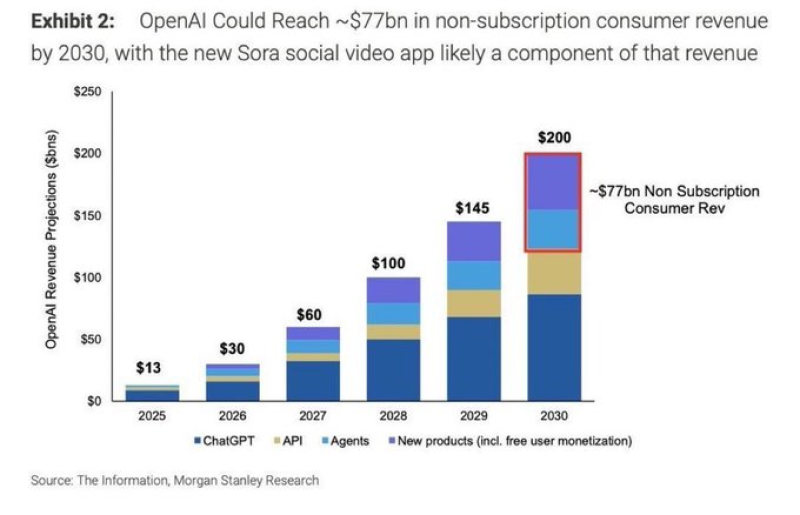
⬤ The most striking part of these projections is where the money comes from. About $77 billion of that 2030 target would need to come from non-subscription consumer products—things like ad-supported platforms, consumer apps, and other ways to monetize free users. That's nearly 40% of total revenue coming from business models OpenAI hasn't fully built yet. The forecast shows this segment really taking off after 2027, meaning OpenAI has a tight window to figure out these new revenue streams.
The scale of monetization required to justify OpenAI's valuation means subscription growth alone won't cut it anymore.
⬤ The company's more traditional revenue sources—ChatGPT subscriptions, API services, and enterprise AI agents—will keep growing steadily but won't carry the load alone. These established segments provide the foundation, but they're projected to grow more linearly based on user adoption and pricing. The real growth acceleration has to come from cracking the code on consumer monetization at massive scale.

⬤ What makes these numbers particularly important is what they say about OpenAI's execution risk. Getting to $200 billion in five years isn't just ambitious—it requires maintaining extremely high growth rates while successfully launching and scaling entirely new product categories. The projections make clear that subscriptions can't be the main growth driver long-term, which puts enormous pressure on OpenAI to nail its product expansion strategy and turn casual user engagement into real, lasting revenue.
 Saad Ullah



