
 Saad Ullah

⬤ Three distinct AI categories now define how companies build automation workflows. A detailed chart breaks down the operational differences between non-agentic AI, agentic AI, and AI agents, showing how each handles specific tasks in modern software environments.

⬤ Non-agentic AI covers basic prompt-response systems without memory, reasoning, or tool integration. These models handle quick, standalone tasks like summarization, rewriting, or simple content generation. They're fast, cheap, and easy to use with no technical setup required. The tradeoff? No context awareness, limited multi-step capabilities, and performance that lives or dies by prompt quality.
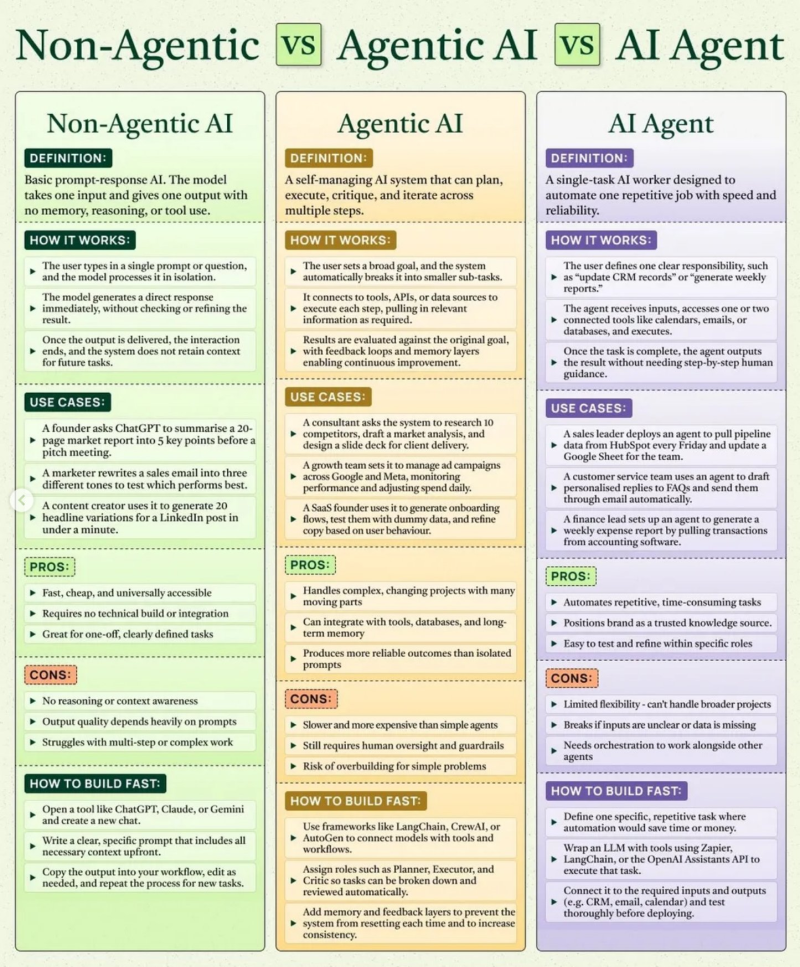
⬤ Agentic AI brings self-managing systems that can plan and execute complex workflows. These models break down objectives into smaller tasks, connect with tools and databases, and deliver consistent results even when project requirements shift. They excel at handling complexity, maintaining long-term memory, and improving through iteration—though they cost more and need human oversight compared to simpler alternatives.
⬤ AI agents focus on single-task automation with speed and reliability. They streamline repetitive work like updating CRM systems, generating recurring reports, or extracting structured data without constant human involvement. Easy to deploy, cost-effective, and simple to validate, they're becoming standard in business operations where narrow, repeatable tasks dominate.
⬤ These distinctions reveal how AI systems are becoming increasingly specialized. Grasping the differences between non-agentic AI, agentic AI, and AI agents is now critical for anyone building automation strategies, especially as organizations mix and match system types to boost efficiency and tackle complex work at scale.
 Saad Ullah



