
 Usman Salis
⬤ A fresh survey called "Memory in the Age of AI Agents" is making waves in the AI community by tackling something we've all been wondering about—how do AI agents actually remember things? The paper does something pretty clever: it creates a unified taxonomy that breaks down memory systems into understandable chunks, giving researchers and developers a roadmap for building smarter AI. This isn't just academic theory—it's a practical guide to how memory mechanisms work in real AI systems and how they evolve over time.
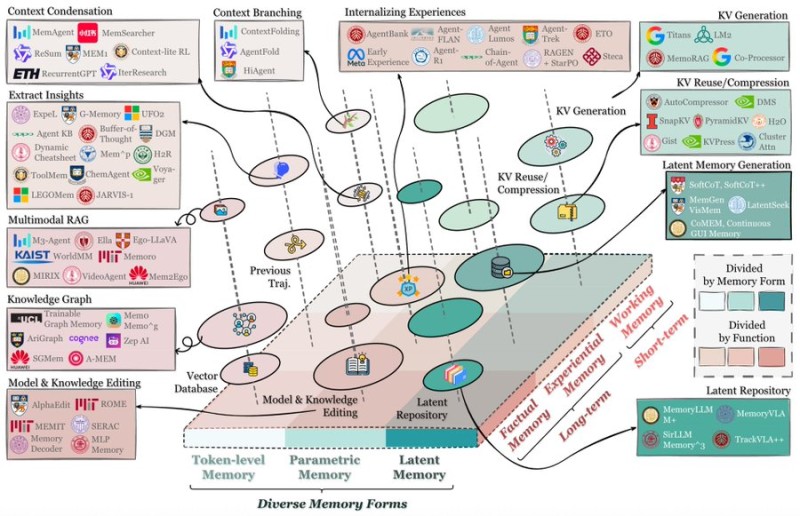
⬤ The research splits agent memory into three main buckets: forms, functions, and dynamics. When it comes to forms, think token-level memory (the nitty-gritty details), parametric memory (what's baked into the model), and latent memory (the hidden representations). The functional side covers the practical stuff—how agents condense context, edit knowledge on the fly, internalize experiences, and pull information from multiple sources like text and images. These aren't isolated features; they work together to make agents better at processing, storing, and recalling information when they need it.
⬤ Where things get interesting is in the dynamics—the real-time adaptability of these systems. The survey explores mechanisms like key-value generation, memory reuse, and compression techniques that let agents update their memory banks based on new inputs and experiences. We're seeing this play out in systems like agent banks, memory graphs, and latent memory repositories. These aren't just buzzwords—they're actual architectures being integrated into AI models right now to create more coherent, long-term memory structures that boost overall performance.
⬤ This survey matters because it's establishing a common language for AI memory research. Instead of everyone building memory systems in isolation, we now have a framework that could accelerate development across the board. The practical applications are already on the horizon—smarter customer service bots, more reliable healthcare assistants, and automated workflows that actually remember context from one interaction to the next. By giving researchers and developers this standardized approach, the survey is laying groundwork that could define how intelligent agents evolve over the next several years.
 Usman Salis



