
 Peter Smith
⬤ ByteDance and Tsinghua University unveiled TurboDiffusion, an inference framework designed to drastically speed up video generation on Nvidia hardware. The team reports acceleration between 100× and 200× on a single RTX 5090 graphics card with minimal quality loss. Now available on GitHub with an accompanying research paper, the framework tackles the compute-heavy diffusion pipelines that currently prevent real-time AI video creation.
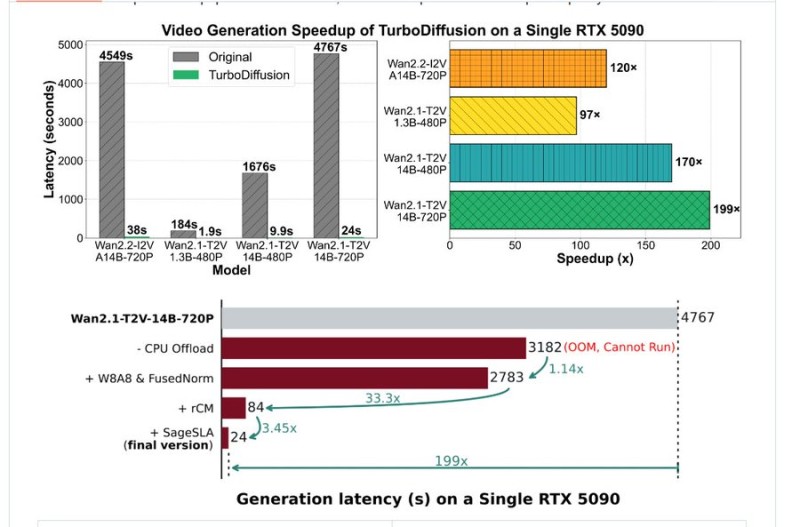
⬤ Performance charts show dramatic latency drops on the RTX 5090 using Wan2.1-T2V models. The 14B-720P model's generation time plummeted from 4,767 seconds to just 24 seconds—a 199× speedup. The 14B-480P version improved from 1,676 seconds to 9.9 seconds, while a smaller 1.3B model jumped from 184 seconds to 1.9 seconds (97× faster). Another benchmark, Wan2.2-I2V-A14B-720P, dropped from 4,549 seconds to 38 seconds. According to the development pipeline, combining CPU offload removal, quantization optimizations, and new attention techniques brought generation times from thousands of seconds down to tens.
⬤ Traditional video diffusion models crawl along because they need dozens to hundreds of denoising steps, each running attention-heavy transformer calculations. TurboDiffusion cuts sampling to around three or four steps using score-regularized continuous-time consistency distillation (rCM), then speeds up attention with Sparse-Linear Attention and low-bit SageAttention. As the researchers note, "this allows Nvidia GPUs such as RTX 5090 to utilize high-throughput tensor core compute paths more effectively." Additional boosts come from W8A8 INT8 quantization and fused normalization kernels.
⬤ This matters because Nvidia (NASDAQ: NVDA) dominates the AI GPU market for training and inference worldwide. Real efficiency breakthroughs could reshape compute demand, model access, and scaling strategies across the industry. If TurboDiffusion delivers real-time AI video on single consumer cards, it could accelerate adoption of video-native AI tools while intensifying competition in both semiconductor and AI software markets.
 Peter Smith



