
 Usman Salis
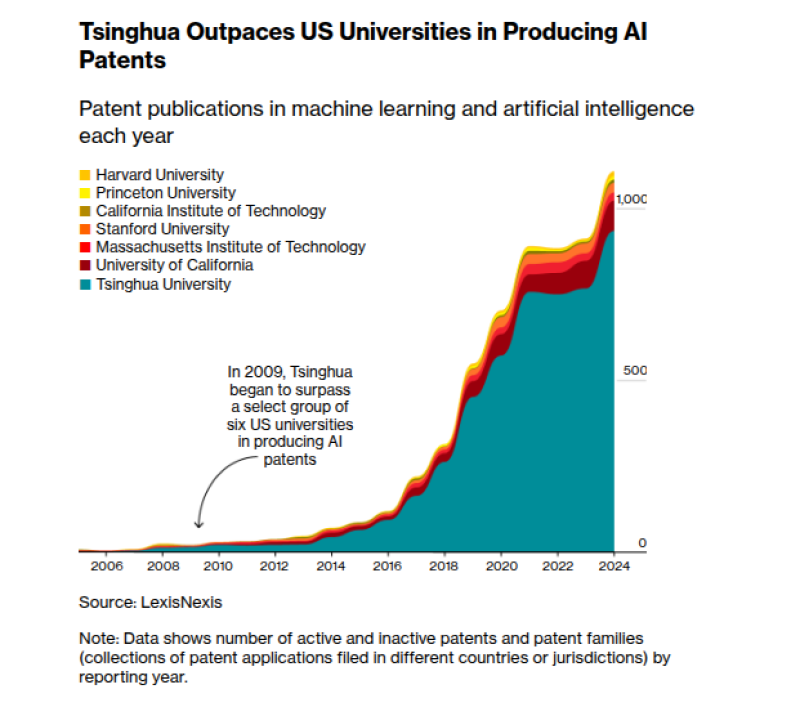
⬤New data from Bloomberg shows Tsinghua University has overtaken America's top universities in AI and machine-learning patents since around 2009 — and the gap keeps growing. The LexisNexis figures compare Tsinghua against Harvard, Princeton, Caltech, Stanford, MIT, and UC. By the early 2020s, Tsinghua's AI patent numbers were way ahead of this elite US group, showing China's sustained push in AI intellectual property.
⬤The numbers tell a story of a system that's firing on all cylinders: funneling top talent into AI research, pushing for patents and publications, and turning that work into startups and real products — all backed by policies designed to speed up the journey from lab to market. China's total patent filings jumped 67.7 times between 2000 and 2024, climbing from about 26,553 to roughly 1.8 million. Meanwhile, the US hit around 503,000 filings and Japan about 421,000 in 2024, making today's IP landscape look completely different from two decades ago.
⬤The Bloomberg chart shows Tsinghua first passing the combined AI-patent output of six major US universities around 2009. Since then, Tsinghua's numbers have climbed steeply, especially from the mid-2010s forward, while US institutions grew at a slower rate. These figures cover both active and inactive patents plus patent families — groups of filings across different countries in the same year.
⬤This surge in AI patents matters because owning intellectual property shapes who leads innovation, controls licensing, and dominates technology long-term. As Tsinghua and China's research network keep expanding their AI-patent portfolio, global supply chains, partnerships, and market competition will increasingly reflect where the AI IP sits — adding another layer to the rapidly shifting tech landscape.
 Usman Salis



