
 Sergey Diakov
⬤ Google's being called out as the only major tech company that actually owns the entire AI stack from top to bottom. According to industry observers, Google controls every critical piece—custom chips, cloud infrastructure, foundation models, and consumer apps. A recent comparison chart shows how the leading players across cloud providers, model developers, and AI applications are all trying to build vertically, but Google's already there.
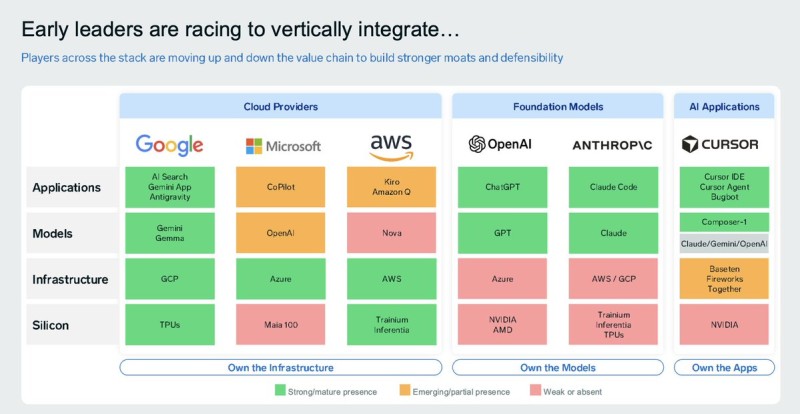
⬤ The breakdown splits the AI ecosystem into four layers: silicon, infrastructure, models, and applications. Google shows up in all four with its own tech—TPUs for chips, Google Cloud Platform for infrastructure, DeepMind's foundation models, and Gemini as the main AI app. Every other company has at least one layer where they're either weak or completely dependent on someone else's technology.
⬤ Microsoft and Amazon are strong on cloud infrastructure and applications but lean on external solutions for chips and models. OpenAI and Anthropic focus on foundation models and apps while renting cloud infrastructure and hardware from others. Application companies like Cursor own their app layer but rely entirely on external models and infrastructure. The chart uses color coding to show strong versus weak presence, and it's pretty clear—nobody else comes close to Google's coverage across all four layers.
⬤ This matters because vertical integration is quickly becoming the name of the game in AI. When you own more of the stack, you can deploy new features faster, optimize systems more tightly, and differentiate your product in ways competitors can't easily copy. As the race heats up across cloud services, foundation models, and AI applications, controlling chips, infrastructure, models, and apps under one roof is turning into the ultimate competitive advantage in the AI sector.
 Sergey Diakov



